


 Subscribe
Right Along With the Grunge Look, the Housing Crisis is Over
May 28, 2008
Yes, for those of you gents who still may be holding on to the rather relaxed “grunge” look from the 1990’s, I’ve got a newsflash for you: grunge, along with the current housing crisis, is over.
Articles about the housing crisis ending have been few and buried in their respective periodical, my favorite of which was in TIME magazine back in February titled, “Ignore the Headlines“. But now we have the Wall Street Journal. claiming that the trough was reached in April with an article from May 6, “The Housing Crisis is Over“.
I agreed with Peter Lynch back in February.., and it’s becoming more an more apparent that the longer prospective home-buyers sit on the fence, the more expensive that home purchase will become. And this is not just because I believe that home prices will rise, it’s also because I believe that both long and short term interest rates will rise. The 10-year Treasury Note, for example, is up over 1/2% since the middle of March, and the 10-year Treasury Note is a decent barometer to use when you want to know what the trend in long term mortgage rates have been.
That written, if you really want to continue with the grunge look, might I suggest saving it for your next camping trip?
As always, kindly consult with your trusted real estate, tax and mortgage professional before seriously considering any home purchase.
Tags: Consumer, For buyers, For sellers, Industry, Mortgage, Palo Alto, palo-alto-real-estate, Real estate, Real estate blogging, real-estate-market
Lies, Damn Lies and Statistics - Part 2
January 16, 2008
I want to underscore the importance of what Kevin is discussing in his post regarding statistics and the actual market activity that they represent. Because the neighborhoods in Menlo Park are not distinguished by ZIP code or city, which are two popular methods of segregating data, it is easy to draw an incorrect interpretation of what is happening there.
The Band-Aid fix that I have been using with my clients interested in Menlo Park is to explain the nature of the market, and then look at the market data for the upper two quartiles of homes only. Conveniently, the homes in the areas of Menlo Park East of 101 are all below the mean for the whole city, while those West of 101 are generally above the mean overall.
Scott at Altos Research sent me the following interesting bit of analysis of how an outlier can throw off the statistics for an area. It seems there was recently at home in Del Mar in Southern California listed for $76 million.
The Median home price is reflected here (Median = half the homes on the market are listed above this price, half below):
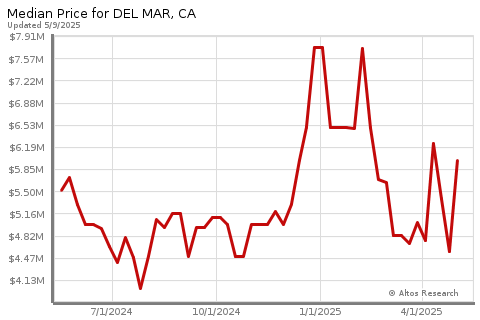
The numbers are weekly, and we can see how having a limited number of data points (homes for sale) bounces the numbers around.
Maximum price for Del Mar during the same period:
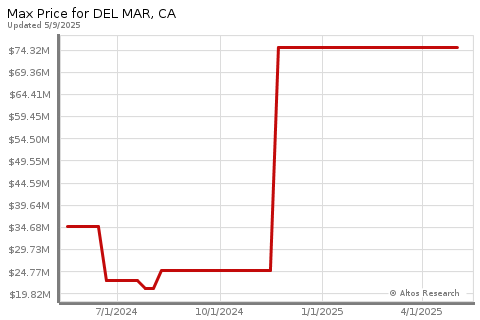
Gee, I wonder when that house was listed, and what the selling commission is?
And here is how the mean (average) price of homes in Del Mar, California is affected as a result:
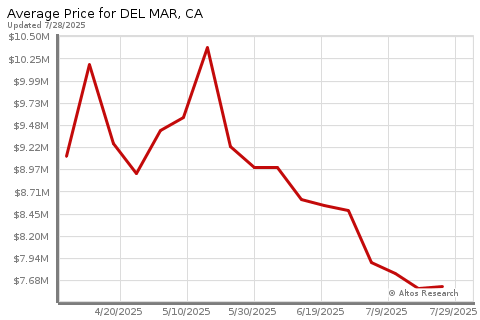
So, the average price of a home in Del Mar, CA took a nice bump, but does that mean that the house at 123 Main Street went up in value by over 50%? Sadly, no. Similarly, when and if that bad boy sells, the mean price of homes in Del Mar will drop correspondingly, but the value of 123 Main will not be affected at all.
So, to all of you living in on the Peninsula crying in your Cheerios because you read in The Chronicle that home values in California are off by 20%, RELAX, and ask your Realtor what is really happening with the market in YOUR neighborhood.
Rember, real estate is LOCAL, especially here.
Thanks for reading.
Tags: Altos Research, average home price, home prices, home values, median home price, Menlo Park, palo alto home prices, real-estate-market, statistics
Mortgage Mania - Part 14, Dubious Fees
November 6, 2007
My favorite online news source, The New York Times, ran a story today “Dubious Fees Hit Borrowers in Foreclosures” in which the writers interviewed Katherine M. Porter, associate professor of law at the University of Iowa. In a review of many loans that are now going into foreclosure, Porter found that questionable practices among lenders are leading some experts to contend that lenders are taking advantage of higher-risk borrowers and those facing foreclosure.
“Because there is little oversight of foreclosure practices and the fees that are charged, bankruptcy specialists fear that some consumers may be losing their homes unnecessarily or that mortgage servicers, who collect loan payments, are profiting from foreclosures.
Bankruptcy specialists say lenders and loan servicers often do not comply with even the most basic legal requirements, like correctly computing the amount a borrower owes on a foreclosed loan or providing proof of holding the mortgage note in question.
“Regulators need to look beyond their current, myopic focus on loan origination and consider how servicers’ calculation and collection practices leave families vulnerable to foreclosure,” said Katherine M. Porter, associate professor of law at the University of Iowa.”
You may be asking what this means to you in Palo Alto, happily making your payments on your $1+ million mortgage on your $2.4 million median priced home (no, that isn’t a typo!). As Mortgage Manics have heard me say before (OK, read), national lenders use a mostly one-size-fits-all approach to lending, meaning that practices and guidelines that are developed and applied to home buyers in Iowa, Tennessee and Colorado are also applied to us here in Silicon Valley. As a result, if you are reading about unscrupulous practices and excessive fees by national lenders that are being exposed in areas with high foreclosure rates, you may want to check the fine print on your mortgage and see what you are paying for in addtion to PITI.
In addtion, Porter found that lenders didn’t provide accurate payoff amounts for their loans to consumers, with one claiming they were owed $1,000,000 when the actual payoff amount was $60,000. That must be that fuzzy math stuff . . .
Countrywide was recently sanctioned by a court in Pittsburgh for losing or destroying over $500,000 in checks between December 2005 and April 2007 for homes in foreclosure. These are the companies holding the title to our homes, so we need to keep an eye on them.
You can read the full text of the article here.
On that happy note, have a great week, and thanks for reading.
Tags: 4---mortgage-mania, 94301, 94303, 94306, bay-area-real-estate, Countrywide, Home buying, Loan-Application, Preapproval, Prequalification, Real estate, real-estate-market, real-estate-prices
Mortgage Mania Part 13 - A Halloween Story
October 31, 2007
Dsiclaimer: The following post is based on a presentation by Christopher Thornberg, an economist at Beacon Economics, that I attended last night, courtesy of my accountant, Tom Wagstaff of Petrinovich, Pugh and Co. This is a departure from my normally upbeat view of the local economy, and fortunately they re-opened the bar following the presentation for all the Realtors in the audience to drown their sorrows.
Economist Chris Thornberg showed some pretty convincing evidence for his expectation that housing prices will fall between 20% and 25% over the next couple of years, primarily because the ratio of home prices to incomes is higher than anytime in history, almost double the peaks in previous economic cycles. Gloom and doom for an hour, ah it brought tears to the eyes of many a Realtor in San Jose. Smugly I said, ” . . .but I live and work in Palo Alto, land of Stanford, Venture Capital, Facebook and Google! Sushi on every table and a BMW in every driveway! We are our own little world here, so we don’t have to worry about the housing market meltdown in Nebraska, or even the East Bay.”
Not so fast. The lastest housing boom has been driven by increasing housing prices, driven in part by cheap credit and loans. More people got these loans, bought more expensive houses, so the demand for these loans went up, and the cycle accelerated.
Now the appreciation is going the other way (flat to negative), and the equity that has driven consumer spending over the last few years (cash out refi = new boat), has gone away (bye, bye boat, and house!). Thornberg forecasts that the subprime meltdown will be followed by Alt - A defaults (already happening) which will pull down the high-end markets from below (that would be Palo Alto, Los Altos, etc.). Even if the Fed were to reduce interest rates to 0%, it wouldn’t fix this mess. Much like last night’s temblor in San Jose, Palo Alto will be on the periphery of this shakeup. We won’t be knocked flat, but we will rock and roll a bit, and not in the fun way. Sigh . . .
To add to the gloom, I have been attending recent forums for candidates for Palo Alto City Council. Whether the topic is Palo Alto’s aging libraries, or green initiatives, the same topics keep coming up: Infrastructure, Schools, Tax revenue.
If you live or work in Palo Alto, I highly recommend you take an interest in the upcoming City Council race and the issues the candidates are raising. You can learn more about the issues and candidates on the Palo Alto Weekly website.
Happy Halloween!!
Tags: 4---mortgage-mania, Buyer and seller tips, Countrywide, Facebook, Google, Google Analytics, Home selling, Loan-Application, Option ARMs, Preapproval, Prequalification, Real estate, real-estate-market, real-estate-prices
Mortgage Mania - Part 7 - It’s almost here!
July 8, 2007
You longtime readers (since March 29th) will remember my original Mortgage Mania article “Subprime Loans - Should Palo Altans Care?” that discussed some potential ripple effects of the subprime lending boom and bust, and the resulting changes in lending requirements for purchasers of million-dollar plus homes in Palo Alto and surrounding communities.
In that article I mentioned that tougher lending standards were on the horizon. Since major lenders do loans all across the country, they take a one-size-fits-all approach to guidelines, and in attempting to shelter themselves from risk associated with rising loan defaults in free-fall markets like Detroit (or Antioch, Gilroy, etc.), for example, they are making changes to lending guidelines that will make it harder for high-income folks with strong credit to buy homes here.
For some in-depth knowledge on this issue, the changing guidelines, and what you can do now if you are in the market for a home, I turn to Curt Van Emon of OPES Advisors, a wealth management firm with offices in Palo Alto, San Mateo and now Los Gatos. OPES is latin for wealth, and my go to source for analysis of what changing lending rules mean to my clients.
Curt is a fellow blogger, so you can read all of his analysis here at financeambition.com. I’ll just give you the summary here.
- As I mentioned back in March, guidelines are changing, and so buyers wanting to use interest-only loans for purchases will need to qualify based on their ability to make payments including principal AND interest.
- It will become harder to qualify for an adjustable rate mortgage than a fixed rate mortgage
- Buyers will qualify for lower loan amounts, meaning less buying power. (Goodbye 4-bedroom house, hello 3 bedroom)
When do the new guidelines take effect? July 22. So, read Curt’s recommendations, mark your calendar and contact your Realtor if you are planning on buying a home anytime soon.
If you aren’t currently working with a Realtor who is financially savvy and can explain what these changes mean to you, I know where to find some.
Stay tuned for updates on if and how these new guidelines affect buyers and the local real estate market in and around Palo Alto.
Thanks for reading . . .
Tags: Area-information, bay-area-real-estate, Buyer and seller tips, Home buying, Loan Application, Option ARMs, Preapproval, Preapproval, Prequalification, Real estate, real-estate-market, Stated Income Stated Assets (SISA), Stated Income Verified Assets (SIVA)
Mortgage Mania - Part 3
April 11, 2007
Last week I mentioned an article written by friend and colleague, Rachel Van Emon at OPES Advisors on the ripple effects of the sub-prime lending crisis and impending changes in lending guidelines.
Things move quickly in this market and industry, so I wanted to draw your attention to a recent article in the San Jose Mercury News saying that the impact will be minimal in the local market, except for some first - time buyers. The sky isn’t falling.
However, the article goes on to note that lenders have changed their guidelines, and that highly leveraged loans that are the bread and butter of first-time homebuyers are going away.
Quote: “He cited a recent young client with a credit score of just over 660 but a relatively short credit history, who is looking to buy her first condominium using 100 percent financing.
“With the guidelines changing, now some of the lenders who would have taken that three weeks ago … can’t do it today,” he said.”
Assuming this young buyer has good cash flow and a salary-based job, she should be a pretty good credit risk for a mortgage. That is how I bought my first home. Local prices are sky-high already, and this could be another barrier to entry for many.
It’s not only first-time buyers who are short on savings and didn’t pick their parents well who are affected. Bay Area buyers are financially sophisticated, and have used interest-only and other non-traditional loans to allow them to divert cash that would be spent on traditional mortgages into higher return investments. Reducing their ability to do that could dampen some of the enthusiam that is contributing to the currently hot market.
Thank for reading, and I welcome your comments.
Tags: For buyers, Home buying, Loan Application, Mortgages, Preapproval, Prequalification, Real estate, real-estate-market, real-estate-prices, Stated Income Stated Assets (SISA), Stated Income Verified Assets (SIVA)
Real estate predictions
August 31, 2006
Every expert has their views on where real estate prices are headed. The various realtor associations regularly issue market forecasts, each real estate professional has his or her own prediction for a particular area, and of course there are also numerous housing economists who opine regularly on the market. But what does the general public think about housing prices? Our friends at www.inklingmarkets.com have come up with an innovative way of finding out, using “prediction markets” or “knowledge markets.” The notion is that if you create a market where people can buy or sell “shares” in certain future events (such as what median home prices will be in a month), the aggregate buying and selling activities of those people will lead to a general consensus. Think of it as being sort of the real estate equivalent of fantasy football. To test out the idea, I’ve created a sample market at Inklingmarkets.com called “Bay Area Real Estate Market in Sep ‘06.” Trading volumes are still a bit thin, but the current market prediction (as of 9:45pm on 8/31/06) for Palo Alto median home sales prices in Sep ‘06 is $1,280,000. Think that number is too high or too low? Go to www.inklingmarkets.com and voice your opinion by buying or selling “shares” in Palo Alto.

Tags: bay-area-real-estate, For buyers, For sellers, Knowledge markets, Palo Alto, palo-alto-real-estate, Prediction markets, Real estate, Real estate data, real-estate-market, real-estate-prices
-
Subscribe
 Subscribe in a reader
-
Contributors

Broker/Owner
3 Oceans Real Estate
Menlo Park, CA
(DRE 01404898)
Realtor
Keller Williams
Palo Alto, CA
(DRE 01708130)
Mortgage Broker
Equitas Capital
San Jose, CA
(DRE 01730869)
Stager
Staged4More
Burlingame, CA

Realtor
Keller Williams
San Jose, CA
(DRE 01385188)
Attorney
RHRC
San Jose, CA

Mortgage Banker
Absolute Mortgage
Palo Alto, CA
(DRE 01361721)

