Tales From The Front – The Market on July 12, 2009
July 13, 2009
Since so much of what we read about the real estate market is looking at it nationally, or statewide, it is easy to forget that real estate is local. In fact, it is probably the only product that still is local.
Here in Los Altos, the market has really picked up starting in early May. Consumer confidence came back as the stock market rallied, the sun came out, flowers bloomed and sellers got more realistic about pricing. Buyers responded by buying up homes faster than they are coming on the market, mopping up inventory.
In June, there were more homes in contract in Santa Clara County than were for sale. The majority are under $500K, but the buying frenzy has moved into the mid-priced homes up to $1.5M. Buyers are finding themselves in multiple offer situations in some cases, with a homes in Los Altos and Palo Alto occassionally receiving over ten offers. . . . What year is it again?!?
Even this new market activity is being regulated by loan availability. I wish I could remember the name of the banker who said that “the lending pendulum has swung to stupid” last week. He is in Nebraska and was saying he can’t do loans now that his father would have happily done in the 1950’s. Home buyers in the dreaded jumbo market are having to provide tremendous documentation and larger down payments, which are softening the market with inflection points at $1.5M (20% down), and $2M (25% down). Over $2M, you need to bring $600,000 in cash, which is a decent chunk of change, especially if you are in the tech industry these days.
Yesterday, I had the pleasure of spending the afternoon at this lovely home in Oak Valley in Cupertino. It is a beautiful home with views and a sparkling pool, priced at $2,348,000. That is at the top of the Cupertino market, but upper-mid range for south Los Altos, which the neighborhood borders. I had plenty of company, as there were a lot of visitors, most of whom are in the market to buy a home, not looking for decorating ideas. The majority had seen the house online, so they knew the size and price before driving over.
Forecasts for the fall market are varying, at best. So don’t believe what you read in the papers, check with your local Realtor. Hopefully, rates will stay low, and we will see inventory continue to be absorbed.
Stay tuned, and thanks for reading . . .
The Market Report – June 2009
June 5, 2009
I send my clients a monthly market update and thought I’d share it with the blogosphere. If you agree and think that I’m a genius, please comment below. If you disagree and think I’m an idiot, keep your thougths to yourself. You can send me an email to subscribe to your city of interest (Atherton, Los Altos, Los Altos Hills, Menlo Park, Mountain View, or Palo Alto), and I’ll add you to my monthly update list. The commentary is as of June 1, 2009, that data is real-time.
May brought a ray of light into the local real estate market, as consumers, boosted by the rising stock market and low interest rates, began buying up homes on the market. Both Pending Sales and Pending Prices are up (see attached chart for a historical comparison), absorption numbers have outpaced new inventory both statewide and locally, and multiple offers on homes in Los Altos and Palo Alto have come back into play. At the low end, investors are superheating the Santa Clara and San Jose markets for single-family homes under $500,000, with many bank owned properties getting 20 – 30 mostly cash or all cash offers.
In general, prices are at about 2004 levels, and interest rates continue to hover near historic lows, with conforming loans under 5% for 30 years, and Jumbo loans staying around 6%. The big question on everyone’s’ mind is, “How long will this last?”
This past week we saw rates on the 10 year bond jump 0.5%, putting upward pressure on mortgage rates, which responded by rising for the different conforming loans. To get some additional input on whether this is short-term volatility or a longer term trend, I called my favorite mortgage bankers, who all had the same opinion, and all disagree (with all due respect) with Fed Chairman Bernanke that we will be out of the woods by the end of 2009.
The abridged version is that the government is subsidizing rates on loans backed by Fannie Mae and Freddie Mac (who are backed by taxpayers), so long-term mortgage rates are unsustainably low. The funds being used to subsidize these loans are finite, and limited, so there is upward pressure on the various conforming rates to rise to the real market rate of 6% as we are seeing in the Jumbo market.
Unusually, BOTH Buyers and Sellers are facing threats from market forces, creating compelling arguments to act now:
Sellers:
- Rising interest rates cut the purchasing power of Buyers, reducing the pool of potential Buyers for a given property
- The threat of rising unemployment and continuing slowing of the economy reduces consumer confidence and spending, especially on big-ticket items like cars and houses
- The current tax incentives for buying homes are limited to 2009. Reduced government from taxes due to lower incomes and corporate earnings makes it less likely that these are extended in 2010.
Buyers:
- That unemployment thing
- Qualifying for mortgages is getting more difficult, and the regulation of the process has tightened, adding new hurdles to the underwriting and appraisal process as the market overcorrects for the Wild West of the last few years.
- Rising rates cut purchasing power
Wow, kind of heavy stuff for a Friday. The good news is that summer is less than 3 weeks away!
On to the numbers:
Atherton:
Currently, the Median Price of a Single Family Home in Atherton is $3,996,500 with a range of $899,000 to 16,800,000. 48% (versus 41% last month) of the homes in Atherton have had price reductions, as Sellers are accepting that the market has shifted, and the average number of Days on Market has risen to 133 days from 114 last month, meaning that we should see more price reductions as the market searches for equilibrium.
Los Altos:
Currently, the Median Price of a Single Family Home in Los Altos is $1,999,900. 36% (up from 32% last month) of the homes in Los Altos have had price reductions, as Sellers are learning that the market has shifted, and the average number of Days on Market has dropped slightly to 98 days versus 96 last month.
Los Altos Hills:
Currently, the Median Price of a Single Family Home in Los Altos Hills is $3,146,500. 36% (up from 23% last month) of the homes in Los Altos Hills have had price reductions, as Sellers are learning that the market has shifted, and the average number of Days on Market has dropped to 173 days versus 187 last month.
Menlo Park:
Currently, the Median Price of a Single Family Home in Menlo Park is $1,447,000. 38% (versus 37% last month) of the homes in Menlo Park have had price reductions, as Sellers are resisting that the market has shifted, and the average number of Days on Market has risen to 127 days from 116 last month.
Mountain View:
Currently, the Median Price of a Single Family Home in Mountain View is $899,000. 55% (versus 38% last month) of the homes in Mountain View have had price reductions, as Sellers are learning that the market has shifted, and the average number of Days on Market has decreased to 121 days from 127 last month.
Palo Alto:
Currently, the Median Price of a Single Family Home in Palo Alto is $1,595,000. 41% (versus 43% last month) of the homes in Palo Alto have had price reductions, as Sellers are resisting accepting that the market has shifted, and the average number of Days on Market has risen to 99 days from 94 last month.
Mortgage Mania 25 – Now What?
November 14, 2008
Henry giveth, and Henry taketh away . . .
When Treasury Secretary, Henry Paulson asked Congress for $750 Billion (yes, that’s with a B) financial bailout package, the justification was to buy up distressed mortgage assets so that banks would start lending again, and hopefully the epidemic of foreclosures sweeping the nation would be stalled.
The new plan doesn’t include that, of course, which has led to everyone asking, now what?
Lately, I have been holding open houses in Palo Alto pretty regularly, and almost everyone coming in asks me the same question: How is the Market? We discuss the market trends of homes taking longer to sell, increasing numbers of price reductions, the importance of pricing and preparation, etc.
The big shift we are seeing now is the effect of the stock market crash last month. Much of the wealth in Silicon Valley is tied to the stock market (options, grants, etc.). It’s how we pay our executives and employees, reward performance (bonuses), and fuel the venture capital engine. When the market drops over 30%, suddenly, potential home buyers are faced with the prospect of selling stock that is devalued by 30% to pull together the down payment on a home that is priced 5 – 10% off its high (typical Palo Alto home, your results may vary). That is pretty tough to justify, and in many cases potential buyers don’t have enough in their portfolios any more to cover the 20 – 30% down needed for that typical Palo Alto home.
So, we are seeing a bunch of Buyers exiting the market, while the inventory of homes for sale in Palo Alto is about double what it was at this time last year. The result is a Buyer’s Market. Good news if you are a Buyer, bad news if you are a Seller.
Many people in Palo Alto don’t NEED to sell their homes. They may be retired and wanting to move to a smaller home or relocate, or they may be a growing family needing more space. With the exceptions of people relocating out of the area, moving into retirement homes, or those who are selling for financial reasons, many sellers can afford to wait for the market to turn in their favor.
In the short-term, I predict that we will see the inventory of homes for sale drop, even more than the usual seasonality, as potential sellers wait out the market. The big threat to sales and prices is interest rates rising. Remember, that if the rate on a loan goes from 6% to 7%, the payment goes up about 15%. That is a big hit when you are talking about $1M loans, and a economy falling into recession.
For the longer term outlook, I’ll defer to this article that was recently in Money magazine that discusses how the credit crisis nationally is affecting ALL real estate, even here in Palo Alto. We Realtors love to say “All Real Estate is Local”, which is great unless the money to buy that local real estate is affected but national events. This time around, the events are international.
Be sure to follow the links above to see the latest market data for Palo Alto and the surrounding communities, but you may want to fix a drink first. Or, you can register to receive updates on the market in local communities delivered to your email weekly at: www.REMarketReports.com
Thanks for reading . . .
Good News About Real Estate in the Mercury? Well Sort Of
September 2, 2008
Long-time readers know that I do my newspaper reading online via the New York Times. In a throwback to a quieter time, I do subscribe to the San Jose Mercury News on Sundays as we like to peruse the articles and share witty banter about the headlines over morning coffee. In an interesting twist, I also receive the paper on other random days of the week . . . but I digress.
When I picked up the paper on Labor Day (Second Sunday?), the headline “Home Sales Raising Hopes” bravely attempted to be seen over the front and center HURRICANE HITS GOP main headline. What’s this I thought, positive news about the housing market from the Merc? Really?
I have grown weary and wary of the Merc and its drumbeat of foreclosure of the week, gloom and doom, and reinforcing that real estate is local, and my market in Palo Alto varies just a bit from south San Jose. If you don’t believe me, visit Altos Research and compare the chart for median home price over the last couple of years in these two cities. The results may surprise you . . .
The Merc got my hopes up with an intro and a couple of quotes from brokers saying they were expecting an upturn in sales in the Fall after activity was so low in the summer, and there is usually an upturn in the fall. There is some back and forth, and the article pretty much shot down the “fall uptick” conventional wisdom. Again, Altos to the rescue showing inventory and sales actually DO pick up in Palo Alto fairly consistently every fall before slowing down over the holidays.
To see the article on its entirety, click here to visit the Mercury online. For charts and stats galore, visit the Market Reports page on my website, now in Single Family and Condo!
Thanks for reading . . .
Economic Forecast – Finally, you can believe what you read in the newspaper
January 21, 2008
I have long been a proponent of Bay Area real estate, and especially that rare piece of level ground on the Peninsula where the laws of Supply and Demand exert the greatest influence.
Amid tales of worldwide stock market tumbles (US markets were closed today in observance of Dr. King’s birthday), this little tidbit of sanity was embedded in an article in today’s online San Jose Mercury News:
Stock slides: Stocks sank around the world today, as U.S. markets remained closed for the Martin Luther King Jr. holiday.
The most dramatic decline was in India. The bellwether Bombay Sensitive Index plunged 1408.35 points, or 7.4 percent – its largest ever single-day drop in points. The pan-European Dow Jones Stoxx 600 index continued its six week slide, falling 5.7 percent to 308.77 percent.
Yet among the spreading gloom, Silicon Valley is shining.
“Silicon Valley is in better shape than the overall U.S. economy,” said John B. Sloven, director of the Stanford Institute for Economic Policy Research. “My overall assessment is the Silicon Valley economy is going to come through this pretty well unscathed.”
Some facts to consider: Prices in Silicon Valley’s wealthiest areas are holding up. Meanwhile, prices are dropping on low-end homes, increasing affordability. The region added jobs in December for the third consecutive month. Finally, the San Jose region is supposed to lead the state in personal income growth over the next few years.
The interesting point is that the falling prices for lower end housing makes things more affordable for first-time homes buyers. My personal experience is currently supporting this, as I have a couple of clients shopping for their first homes in the $600,000 – $650,000 range, and are seeing personal benefit as homes that were recently listed tantilizingly close to their range, but just out of reach, at $700,000, are now being reduced to under $650,000.
The amazing thing about this area is that the economy continues to reinvent itself, the economic engine continues to churn through economic expansion and recession, and housing remains a scarce commodity because we have very little land to build new housing on.
Not to sound self-serving, but it is a great time to buy real estate here in Silicon Valley, especially if you can scrounge together a 20% down payment and have a history of actually paying your bills. Prices in some areas are down, flat in others, and interest rates continue to be near historic lows.
Donald Trump recently announced that he is seeking investors for a fund that will invest $100 million in California real estate in the next couple of years.
If California real estate is good enough for The Donald, isn’t it good enough for the rest of us?
Thanks for reading.
Lies, Damn Lies and Statistics – Part 2
January 16, 2008
I want to underscore the importance of what Kevin is discussing in his post regarding statistics and the actual market activity that they represent. Because the neighborhoods in Menlo Park are not distinguished by ZIP code or city, which are two popular methods of segregating data, it is easy to draw an incorrect interpretation of what is happening there.
The Band-Aid fix that I have been using with my clients interested in Menlo Park is to explain the nature of the market, and then look at the market data for the upper two quartiles of homes only. Conveniently, the homes in the areas of Menlo Park East of 101 are all below the mean for the whole city, while those West of 101 are generally above the mean overall.
Scott at Altos Research sent me the following interesting bit of analysis of how an outlier can throw off the statistics for an area. It seems there was recently at home in Del Mar in Southern California listed for $76 million.
The Median home price is reflected here (Median = half the homes on the market are listed above this price, half below):
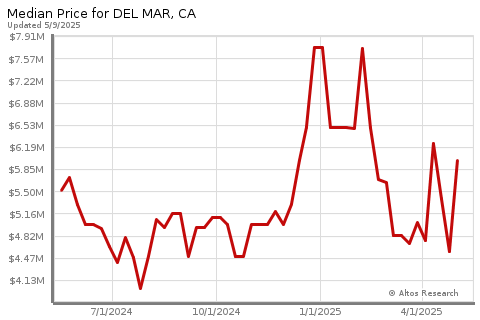
The numbers are weekly, and we can see how having a limited number of data points (homes for sale) bounces the numbers around.
Maximum price for Del Mar during the same period:
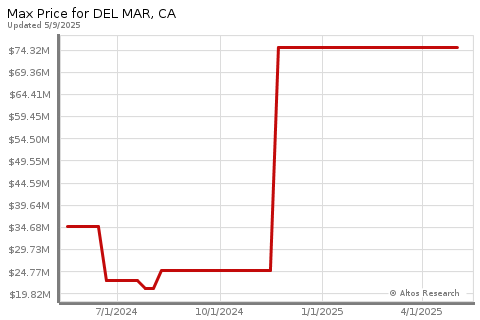
Gee, I wonder when that house was listed, and what the selling commission is?
And here is how the mean (average) price of homes in Del Mar, California is affected as a result:
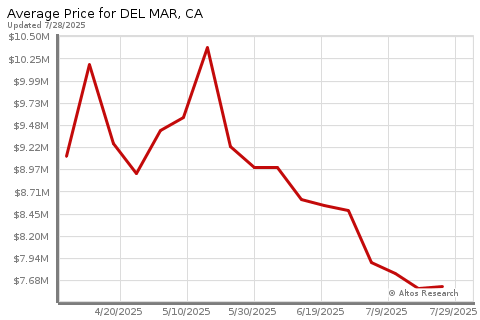
So, the average price of a home in Del Mar, CA took a nice bump, but does that mean that the house at 123 Main Street went up in value by over 50%? Sadly, no. Similarly, when and if that bad boy sells, the mean price of homes in Del Mar will drop correspondingly, but the value of 123 Main will not be affected at all.
So, to all of you living in on the Peninsula crying in your Cheerios because you read in The Chronicle that home values in California are off by 20%, RELAX, and ask your Realtor what is really happening with the market in YOUR neighborhood.
Rember, real estate is LOCAL, especially here.
Thanks for reading.


Subscribe
